Village of Mamaroneck · Westchester County, New York

Thirty-six seasons.Then nothing.

For 36 consecutive seasons the Village of Mamaroneck treated its tidal marshes, creek edges and catch basins with a natural larvicide. In 2025 the program was canceled. This is the documented record of what happened next, assembled from Village statements, State correspondence, permits and public meetings.

1989
2025 — today
Program running · 1989–2024
No program
This Thursday Committee for the Environment · Thursday August 6, 7:30 PM · Courtroom, 169 Mt. Pleasant Avenue

The short version

Five things to know

36

Consecutive seasons the Village ran a mosquito control program, from 1989 through 2024.

Bti

The larvicide used. A naturally occurring soil bacterium. Harmless to people, pets, fish and bees. Works within hours, lasts about 30 days.

2

Letters the State Comptroller's Office sent on July 16, 2026. Both say the decision belongs to the Village.

118

Households that signed a formal public health request to Westchester County on July 22, 2026.

$0

Spent on insect control in 2026, out of the $20,000 the Board adopted for it. The program cost roughly $5,500 to $6,300 a year when it ran.

Residents are coordinating by email at mosquitoes-2026@googlegroups.com — write to join, to speak at a meeting, or to send a document or correction. Meeting dates are under Take Action.

The central misreading

The Board cannot act without a declaration of a public health emergency.

Mayor Torres, Board of Trustees legislative meeting, July 13, 2026. Full video record available through LMC Media.

The law exists to prevent an emergency, not to wait for one.

What the statute is

Public Health Law Article 15, Title 1 is headed Municipal Insect Control. It is standing authority, not emergency power. It is the framework the State Comptroller's Office pointed the Village Attorney to in May 2026, and it contains no requirement that an emergency be declared first.

What the threshold is

The statute empowers a municipality to act where a breeding place "constitutes a danger or injury to life or health."

Danger is prospective. The word does its work before anyone is harmed. Reading the statute to require an emergency collapses "danger" into "injury" and removes the entire preventive half of the sentence.

And on standing water

The statute declares any accumulation of water in which mosquitoes breed to be a nuisance — as a matter of law, automatically, with no declaration by anyone required to make it one.

A village that waits for an emergency to treat a nuisance the statute has already defined has inverted the purpose of the law it is citing.

Statutory language as quoted in resident correspondence to the Board, July 21, 2026. Readers are encouraged to check the text directly at nysenate.gov. A timestamp for the Mayor's remark in the July 13 video record is being confirmed.

Scope

This was never one neighborhood's problem

The original justification for cutting the program was that it benefited a small area. Mosquitoes do not work that way, and the distances are not close.

1–3 mi

Typical flight range of Culex pipiens, the species most likely to carry West Nile virus. Further with wind. That radius covers most of the Village.

20 mi

Range of salt marsh mosquitoes. Up to 40 miles with wind.

½ inch

Depth of standing water sufficient to breed. A bucket, a flower pot, a birdbath, a clogged gutter, a garbage can lid.

4–14

Days a larva spends underwater before becoming a pupa, then an adult within 1 to 4 more days. A single female lays 50 to 300 eggs.

Neighborhoods affected

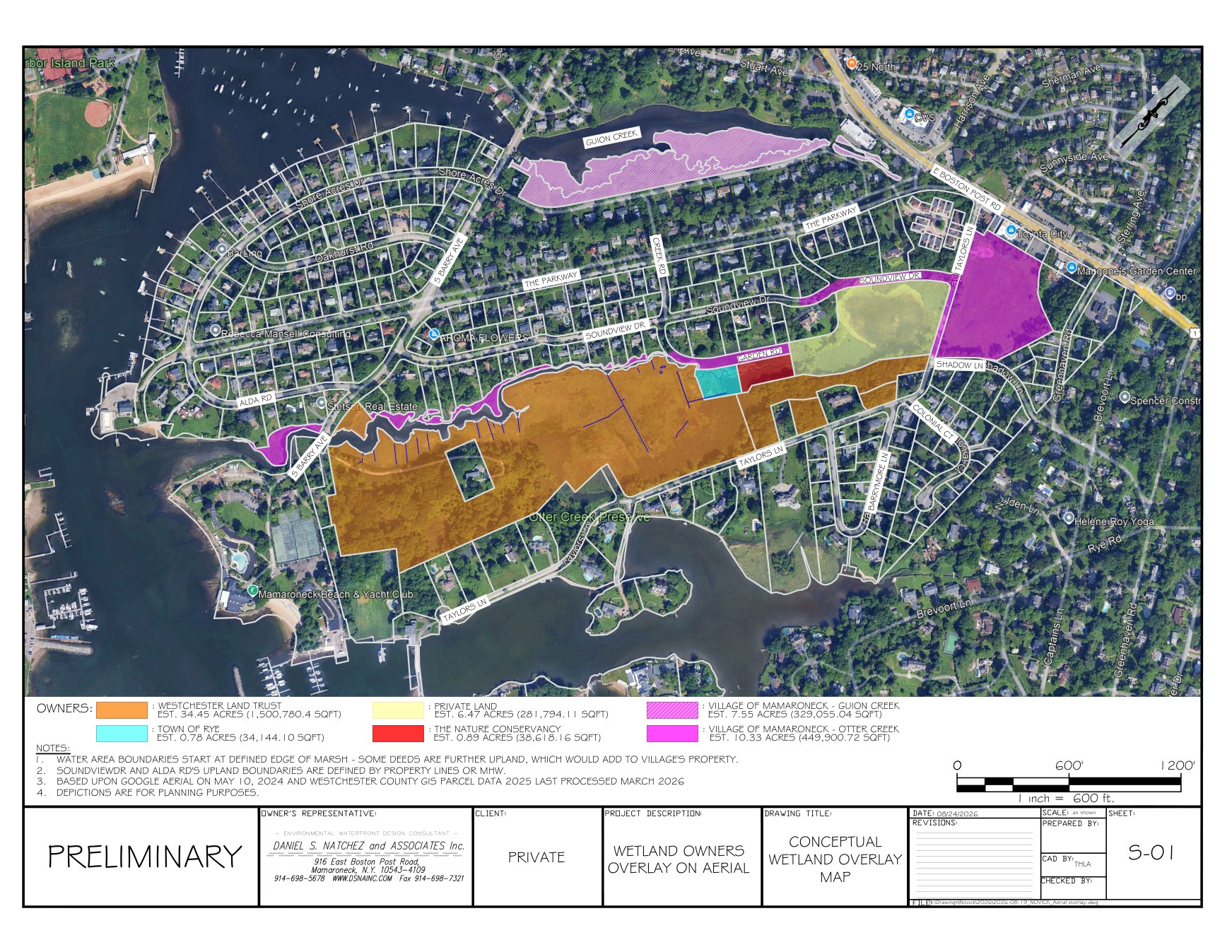
Shore Acres — Shore Acres Drive, Oakhurst, Alda, Soundview, South Barry
Lawn Terrace
Guion Creek area — Stuart, South Barry
Taylors Lane area — Barrymore, Colonial Court
Beaver Swamp Brook area — Sunnyside, Hornidge
Greenhaven — Van Amringe Millpond
Beach, Melbourne and Union areas

Plus everyone who works in these neighborhoods: mail carriers, sanitation crews, landscapers, contractors and delivery drivers.

Why the range matters legally

The gift-clause objection rests on the premise that treatment benefits a handful of private landowners. If the mosquitoes bred at a marsh reach households one to three miles away, the beneficiary is the public — which is the test the statute actually applies.

And even if it were one or two neighborhoods: a rat problem in an industrial district, a flooding problem in the Flats, and a mosquito problem on the waterfront are the same kind of problem. When the cause is larger than any single property owner can address, that is precisely when a municipality steps in.

Three meetings in August

Please come. Attendance is the thing that has moved this.

Every step of progress so far followed residents filling a room. Thursday is the soonest. On August 10 there are two sessions in the same room, and the 5:30 work session is where turnout counts most.

This Thursday

Thursday, August 6
7:30 PM

Committee for the Environment

Courtroom
169 Mt. Pleasant Avenue, Mamaroneck

The Committee advises the Board on this issue, and it has a draft resolution that is exactly right. This is the same committee that recommended larvicide treatment in October 2025 and was not listened to.

Deputy Mayor and Trustee Nora Lucas will be there. The public will be able to speak.

The most effective format is a few designated speakers taking specific topics, with everyone else piling on afterward — either simply by being in the room, or by adding whatever you want to say.

The Committee is already on residents' side, so the most useful comments here are forward-looking: specific actions for the short and longer term, and any changes to the draft resolution.

Bodies needed here

Monday, August 10
5:30 PM

Board of Trustees, Work Session

Village Courtroom
169 Mt. Pleasant Avenue, Mamaroneck

This is the session where Trustees actually discuss matters among themselves. At the July 13 legislative meeting residents were allowed to speak but the Board was barred from engaging in any discussion. A work session is different.

It starts an hour and a half before the legislative meeting, in the same room. Coming to both means one trip.

Turnout here matters most. Please come at 5:30 if you can.

Then stay for this

Monday, August 10
7:30 PM

Board of Trustees, Legislative Meeting

Village Courtroom
169 Mt. Pleasant Avenue, Mamaroneck

The public can speak without being on the agenda. Any resident should come — this is not a Shore Acres or Taylors Lane matter. Anywhere there is standing water is the problem.

The most effective format is a few designated speakers on specific topics, with everyone else present in support and adding whatever they wish.

This is the body that can actually restore the program.

Get in touch

Join the group, send a document, or volunteer to speak

Residents are coordinating by email. Write if you want to be added, if you can speak at a meeting, if you hold a record that belongs on this page, or if you have found an error here.

mosquitoes-2026@googlegroups.com

Contact the Village directly

Village Manager

Kathleen Gill

KGill@vomny.org

Mayor & Board of Trustees

All Trustees, one addressMayor Torres, Deputy Mayor Lucas, Trustees DeRose, Kushnick and Silver

MayorandBoard@vomny.org

Village Attorney

Steven Pambianchi

spambianchi@vomny.org

Individual accounts of your own experience are the most useful thing you can send, and copying the Mayor and Board keeps a written record. Letters sent to the Village are treated as public records.

What residents are asking for

Four things, none of them new

This is a request to restore what the Village did for 36 seasons. It is not a request to spray private yards.

A

Fund Bti treatment across the entirety of Otter Creek Preserve

For the remainder of this season and every season after, and reimburse the Land Trust for what it has already paid.

B

Treat the standing water at the Guion Creek perimeter

This season and every season after, as was done for decades. Guion Creek is not Land Trust property and never was.

C

Treat the catch basins in all affected neighborhoods

On a May to September schedule, reapplying after each monthly cleaning.

D

Treat Village-owned public spaces

The Parkway median, the meadows at Shore Acres Drive and Lawn Terrace, and the Taylors Lane areas, to address the adult population already flying.

What residents are not asking for

Chemical adulticide spraying of private yards. Nobody has requested it. Residents are already treating their own properties at their own expense. Bti larvicide on public land and permitted areas is a different thing entirely, and it is the thing that was done here for 36 seasons.

Also asked for

A published comprehensive plan with a commitment for future seasons, one that acknowledges this affects most of the Village rather than one or two neighborhoods — and a public Board vote on the resolutions proposed by the Committee for the Environment.

Reminder

The two meetings, again

Thu Aug 6, 7:30pm
Committee for the Environment. Courtroom, 169 Mt. Pleasant Avenue. Draft resolution on the agenda. Deputy Mayor Nora Lucas will be present. Public comment welcome.
Mon Aug 10, 5:30pm
Board of Trustees work session. Village Courtroom, 169 Mt. Pleasant Avenue. This is where Trustees discuss among themselves. Turnout here matters most.
Mon Aug 10, 7:30pm
Board of Trustees legislative meeting. Same room, immediately after. Public comment does not require being on the agenda.
Between now and then
Keep calling and writing to the Trustees and the Village Manager about your own specific experience. Individual accounts from outside Shore Acres are the most valuable thing still missing from the record.
Peak season
Mosquito activity and West Nile transmission run through September.
Get in touch
To join the resident group, offer a document, correct something on this page, or volunteer to speak at a meeting: mosquitoes-2026@googlegroups.com

Side by side

What was said, and what the record shows

Each pairing below quotes a Village statement alongside a primary document. Every source is listed at the bottom of this page.

The Village said

"The verbal guidance received to date has indicated that using public funds for work on private property is not permissible under General Municipal Law and the New York State Constitution. Until written guidance is received and reviewed, the Village cannot make a determination."

Village Statement Regarding Mosquito Concerns Near Otter Creek Preserve, posted to the Village website; repeated at the Board of Trustees meeting of July 13, 2026.

The record shows

The State Comptroller's Office wrote to the Village Attorney that the website "contains inaccurate assertions," adding: "These statements do not accurately reflect our conversation or applicable law," and "The Public Health law unambiguously vests this decision with the municipality." The office asked the Village to correct the statement.

Office of the State Comptroller, Division of Legal Services, letter to Village Attorney, July 16, 2026, quoted at length in resident correspondence to the Board dated July 21, 2026. The Village statement was removed from the website on or about July 20. No correction has been posted.

The Village said

"The VOM does not have a board of health because that authority lies with Westchester County, consequently, the Village has no authority to declare a health emergency."

Deputy Mayor, email to a resident, July 20, 2026.

The record shows

New York Public Health Law § 302 provides that "in villages the board of health shall consist of the board of trustees of the village."

The Comptroller's Office directed the question to the Village Board, not to the County, citing Public Health Law Article 15, Title 1 — Municipal Insect Control.

NY Public Health Law § 302. Office of the State Comptroller letter, July 16, 2026.

The Village said

Bti is not effective in catch basins, because the basins are cleaned monthly under the flood mitigation program and the larvicide must remain in place for roughly 30 days.

Village Manager, as reported in local coverage, July 2026.

The record shows

Catch basins are built with a sump below the inflow and outflow pipes. There is always water sitting in the sump. That is the design. A basin that has just been cleaned still holds water, and still breeds.

Bti begins killing larvae within hours, with a visible difference in about 48 hours, and remains effective for up to 30 days. Reapplying immediately after each monthly cleaning does not conflict with the cleaning schedule — it matches it almost exactly.

Catch basin sump design, confirmable with the Village Department of Public Works. Product characteristics of Bacillus thuringiensis israelensis. Corroborated by neighboring municipalities that treat catch basins on a monthly cycle.

The Village said

To the Village Manager's knowledge, Guion Creek was never treated with larvicide. Separately, that Guion Creek is tidal and so larvicide cannot remain in place long enough to work.

Village Manager, resident correspondence, July 30, 2026.

The record shows

The Westchester Land Trust states that "the original Village program included Guion Creek." A former Mayor states that from 2019 through 2023 the Village retained licensed professionals to apply larvicide at both Guion Creek and Otter Creek.

Bti is applied to standing water at the margins of a tidal creek, not to the moving channel.

Westchester Land Trust, Vice President of Conservation, email, July 8, 2026. Former Mayor, email to residents, July 29, 2026.

The Village said

Otter Creek Preserve is privately owned land. The Village must therefore review whether public funds may lawfully be used to treat it.

Village Statement Regarding Mosquito Concerns Near Otter Creek Preserve.

? Residents have raised

Not yet verified

That Otter Creek has been deemed a navigable waterway. If so, the creek itself would be municipal property. The Land Trust would own the surrounding preserve, but the Village would own the creek and the pools of water that actually need treating — which would remove the private-property question from the central case entirely.

(to be fact checked for accuracy — this point has been raised by residents but has not been confirmed against DEC tidal wetlands mapping or reviewed by counsel. It should not be relied on until it has been.)

Resident group letter to the Mayor and Board, July 14, 2026.

The legal argument

What the Village Attorney argued, and where it comes apart

At the March 2026 budget meeting the Village Attorney delivered a prepared statement explaining why the program could not be funded. It was not on the agenda, so residents who had come to speak had no opportunity to respond to reasoning they were hearing for the first time.

The argument as presented

Paying for larvicide at Otter Creek Preserve would violate the Gifts and Loans Clause, because it would spend public money for the benefit of a private landowner and a small number of nearby homeowners.

The analogy offered was rats in the Washingtonville area: that the "onus can not be on a municipality to benefit a small area, in violation of the Gifts and Loan Clause."

Village Attorney, prepared statement, Board of Trustees budget meeting, March 2026. Available on the LMC Media video record at approximately 14:22. (meeting date given variously as March 9 and March 23 — to be confirmed against the video)

Where it breaks

The statute the Attorney cited actually sets up a two-step test, and he described both steps correctly:

§ 1501 — if mosquitoes breeding on private property constitute a public nuisance, the municipality may compel treatment.

§ 1502 — if the benefit of that treatment is greater to the public than to the private owner, the public bears the cost.

That is the correct reading. The problem is what happens next. Having invoked § 1501 on the basis that the public is the party at risk, and § 1502 on the basis that the greater beneficiary bears the cost, the argument then reassigns the cost to a different set of private homeowners who happen to live nearby. Under ordinary statutory construction those two moves cannot both stand. If the public is the beneficiary, the public body is the payer.

Two months later, the State weighed in

The Village Attorney wrote to the Office of the State Comptroller on April 6, 2026. On or about May 19 that office reviewed with him the factors under Public Health Law Article 15, Title 1, informed him the determination must be made locally, and considered the matter closed.

On July 16 the same office wrote that the Public Health Law "unambiguously vests this decision with the municipality."

How the question was put to the State

The Village Attorney's April 6 request has now been produced. It was sent at 11:48am to the Comptroller's local government unit and, simultaneously, to the Attorney General's opinions office. He forwarded a copy to the Mayor, the Board, the Village Manager, the Assistant Village Manager and the Clerk on July 14, 2026 — the day after the Board meeting at which the public was told the Village was still waiting to hear back.

No response from the Attorney General has been made public. That is an open question worth pursuing: two state bodies were asked, and only one answer is on the record.

Village Attorney · Informal Opinion Request Village of Mamaroneck Mosquito Suppression April 6, 2026, 11:48am To the State Comptroller and the Attorney General
This was a practice undertaken by the Village since 1989 and was ceased last year upon a new Village administration deeming it inappropriate and without legal authority.

The Village's own attorney, writing to the State. The program did not lapse, and it was not lost to a budget shortfall or a permit problem. It was stopped because the incoming administration decided it should be.

My concern here is the spraying of mosquitoes that primarily benefits certain private property owners, but arguably not the greater public. Selective treatment of individual properties for spraying can be construed as a violation of the State Constitution.

This describes a program that did not exist. What the Village ran for 36 seasons was area-wide larviciding of tidal marshes, creek edges and municipal catch basins — not selective spraying of individual yards. The State was asked to rule on a mischaracterization.

Mosquito control measures can be taken by private property owners should they see fit.

A resident who helped conceive the program in 1986, as a member of the Coastal Zone Management Commission, states this is not correct. The entomological surveys underpinning the program found that property-by-property treatment cannot control mosquitoes bred in tidal marshes. That finding is the reason a municipal program was created.

while it appears to me that this is an inappropriate action for the Village to engage in in the aforementioned manner performed, until 2025, since 1989, many residents are upset about the ceasing of this program

The request states its own preferred conclusion before asking for one. The State declined to adopt it.

Three problems with the request

1. It treats "may" as a prohibition. The letter quotes Public Health Law § 1500(1), that a board of health "may take all necessary and proper steps for the control of mosquitoes," and adds: "Please note the may permissive language used."

But "may" is a grant of authority. It establishes that a municipality is not obliged to act. Nobody has argued the Village was compelled. The question was whether it was permitted, and the word cited to prove it was not is the very word that shows it was.

2. It is circular. The argument rests on § 1501 and § 1502, both of which operate through "the board of health of a municipality" making a determination and apportioning cost. Those provisions presuppose that the Village has a board of health with power to act.

Yet the Village has publicly maintained that it has no board of health, and that the authority lies with the County. Both positions cannot hold. If the Village is a board of health — as Public Health Law § 302 provides — then § 1500 empowers it to act. If it is not, then § 1501 and § 1502 give it nothing to rely on either.

3. It is the origin of the billing plan. The letter reads § 1501 and § 1502 to mean the cost should fall on benefited landowners rather than the Village, noting that "the Village bore the expense, and not the individually benefitted property owners."

That reading is what surfaced on July 28 as a proposal to spray Shore Acres properties and bill residents. But § 1501 requires a board of health determination first, and § 1502 apportions cost among those "benefited" — which, where mosquitoes travel one to three miles, is the public.

Office of the State Comptroller · Division of Legal Services July 16, 2026 Signed Eric Eichenlaub, Associate Counsel cc: Village Attorney
On April 6, 2026, we received a written inquiry from the Village Attorney regarding whether the Village may fund the application of larvicide on private property, a practice which we understand the Village has undertaken since 1989 but was apparently recently curtailed.

The State's own record of the program's start date, and of its cancellation.

We informed the Village Attorney that this is something that must be determined locally and considered the matter closed following that dialogue.

Written on July 16. The Village had been telling residents for six weeks that it was still waiting to hear back.

Ultimately, under applicable law, the Village Board is required to consider the individual facts and circumstances presented, weighing the relative public health and private benefits of the proposed action. This Office is not legally empowered to render a decision regarding this program.

There was never going to be a letter from Albany granting or refusing permission. The decision sat with the Board the entire time.

These statements do not accurately reflect our conversation or applicable law. The Public Health law unambiguously vests this decision with the municipality.

From the second letter of the same day, addressed to the Village Attorney, which asked the Village to correct the statement on its website. The statement was removed on or about July 20. No correction has been posted.

What the statute actually says

Public Health Law §§ 1500–1502Authorizes a municipality to take all necessary and proper steps for the control of mosquitoes that are detrimental to health.

On standing waterDeclares any accumulation of water in which mosquitoes breed to be a nuisance.

On the threshold for actingEmpowers the municipality to act where a breeding place constitutes a danger or injury to life or health.

And on the gift clause

The Court of Appeals has held for decades that the Gifts and Loans Clause does not bar public spending where public health is the predominant purpose and any private benefit is incidental.

Bordeleau v. State of New York, 18 N.Y.3d 305. Murphy v. Erie County, 28 N.Y.2d 80.

Separately, Village Law § 4-412 empowers a village board to act for the safety, health, comfort and general welfare of its inhabitants — independent of the board of health question.

How to check this

Sources

Everything above comes from a primary document, a public meeting, or named correspondence. Where an account is disputed, both accounts are given.

  • Westchester County Department of Health, Field Activity Report — Nuisance Complaint, Elevated Mosquito Activity in the Shore Acres Peninsula and Otter Creek Area, inspected July 27–28, 2026, report dated August 4, 2026. Includes catch basin inspection table, water sample sites, GIS floodplain and wetland mapping, and 1947 and 1960 historical aerial imagery.
  • Village Attorney, Informal Opinion Request — Village of Mamaroneck Mosquito Suppression, sent to the State Comptroller's local government unit and the Attorney General's opinions office, April 6, 2026; forwarded to the Mayor, Board, Village Manager, Assistant Village Manager and Clerk on July 14, 2026. No response from the Attorney General has been made public.
  • Village of Mamaroneck Budget Preparation Report, Dept 4086 Insect Control, prepared March 17, 2026, page 64 of 143.
  • Office of the State Comptroller, Division of Legal Services, letter to a resident, July 16, 2026. Signed by Associate Counsel; copied to the Village Attorney.
  • Office of the State Comptroller, letter to the Village Attorney, July 16, 2026, quoted at length in resident correspondence to the Board dated July 21, 2026.
  • NY Public Health Law § 302 — village board of health. § 1305 — nuisance abatement. Article 15, Title 1, §§ 1500–1502 — municipal insect control.
  • Village Law § 4-412 — general village powers for the safety, health, comfort and general welfare of inhabitants.
  • Bordeleau v. State of New York, 18 N.Y.3d 305; Murphy v. Erie County, 28 N.Y.2d 80 — on public purpose and incidental private benefit.
  • Village of Mamaroneck Local Waterfront Revitalization Program, 1984–85, adopted November 1984. Available on the Village website.
  • Village Statement Regarding Mosquito Concerns Near Otter Creek Preserve, Office of the Village Manager. Removed from the Village website on or about July 20, 2026.
  • Board of Trustees legislative meeting, July 13, 2026 — full video record available through LMC Media.
  • Committee for the Environment, Draft Resolution re Mosquito Control, discussion draft dated July 27, 2026, and the Committee's letter to the Board of October 6, 2025.
  • Westchester Land Trust, Vice President of Conservation, correspondence of July 8 and July 22, 2026, and the DEC permit issued June 2026.
  • Formal request to the Westchester County Department of Health, July 22, 2026, 118 signatory households, with photographic exhibits.
  • Former Mayor, email to residents, July 29, 2026, on the 2018 permit lapse and treatment from 2019 through 2023.
  • New York Times, August 13, 1989 — contemporaneous coverage of the original Bti pilot.
  • New York State Department of Health weekly arbovirus surveillance reports, 2026 season.

The money

The funding was never removed. It was simply not spent.

The Village's own Budget Preparation Report, prepared March 17, 2026, sets out five years of the insect control account side by side. It settles several questions at once.

Village of Mamaroneck · Budget Preparation Report Prepared March 17, 2026 Dept 4086 — Insect Control Page 64 of 143

2024 actual$5,460.15 — supplies

2025 actual$6,318.80 — contract services

2026 adopted budget$20,000 — $2,000 spraying and larvae control, $6,000 Village catch basin larvicide, $12,000 contract services

2026 adjusted budget$20,000 — unchanged

2026 actual$0.00

2027 requested and tentative$12,000, a 40 percent reduction. The spraying and larvae control line is requested at $0.00.

What this establishes

The money was there. The Board adopted $20,000 for insect control and left it unchanged on adjustment. Whatever happened in 2026, it was not a funding shortfall.

Nothing was spent. The actual expenditure column reads zero.

The program was inexpensive. Actual spending in the two prior years was $5,460.15 and $6,318.80. Roughly six thousand dollars a year protected an area of some 975 residents.

And what is planned next

The same report, prepared in March 2026, requests a 40 percent reduction for 2027 and zeroes out the spraying and larvae control line entirely.

That request was being prepared while residents were being told that a consultant would be engaged to design a program for future years.

One item to confirm: the Village's fiscal year boundaries, which determine which mosquito season each column corresponds to. If the fiscal year runs June through May, the 2025 figure covers the last season the program operated and the 2026 zero covers the first season it did not.

Village Clerk · FOIL acknowledgment Request #10628 Filed and acknowledged August 4, 2026 Response expected on or about September 1, 2026

A resident filed a Freedom of Information Law request on August 4, 2026, for every financial record tied to Department 4086, Insect Control: ledgers, transaction and expenditure reports, purchase orders and requisitions, invoices, vendor payments, check registers, and permits. The request also reaches expenditures for mosquito control charged to any other department or budget line, and specifically asks about David Ballone, a certified commercial pesticide applicator, in case in-house licensing has been pursued.

The period requested is January 1, 2022 through January 1, 2024, and January 1, 2025 through the date the request is fulfilled — deliberately leaving out 2024, the last full year the program ran without incident, so the response isolates the years in dispute.

Please be advised that the Village is working to determine whether the Village is in possession of any records that are encompassed by your request, and if so, whether they may be withheld or must be disclosed pursuant to FOIL.

Signed by Village Clerk Sally J. Roberts. A response is expected on or about September 1, 2026 — after both the August 6 Committee meeting and the August 10 Board meeting.

Westchester County Department of Health · Field Activity Report Inspected July 27–28, 2026 Report dated August 4, 2026 Senior Public Health Sanitarian
Mosquito density was sufficient to interfere with the inspection, resulting in numerous bites within a short period. Due to the intensity of mosquito activity, the inspection team withdrew to the vehicle and continued the investigation from accessible roadways.

County inspectors were driven out of Otter Creek Preserve. They record sustaining numerous bites at every wetland location despite minimizing exposure, and adult mosquitoes entering the inspection vehicle at each site, requiring it to be ventilated before travel could continue. The report concludes these observations "are consistent with the nuisance complaints received from area residents."

area residents reported that several homeowners have been independently treating nearby catch basins with Bacillus thuringiensis israelensis (Bti), which may have contributed to the limited larval activity observed within the stormwater infrastructure.

The County itself identifies the false negative. Larvae turned up in only one of sixteen catch basins inspected — and the report says the reason may be that residents have been treating the basins themselves. Low larval counts in drains residents have been dosing with Bti are not evidence those drains do not breed mosquitoes.

The extensive stands of phragmites create sheltered microhabitats that reduce wind movement, limit predator access, and promote the formation of stagnant or slow-moving water, all of which provide favorable resting and breeding habitat for adult mosquitoes.

On Phragmites australis, the invasive common reed found throughout the wetland system. A root cause, and one no amount of catch basin treatment addresses.

Historic aerial photographs from 1947 indicate that the current pond did not exist and that Otter Creek historically occupied what is now the pond basin. By 1960, aerial imagery showed the construction of a swimming pool within the former creek channel and the presence of an apparent earthen or structural barrier immediately north of the pool.

The most significant new finding in the report. A man-made alteration to the drainage pattern appears to have created the stagnant pond, reducing tidal exchange and circulation. The report notes that engineering or hydrologic evaluation would be needed to confirm it — precisely the work a task force should commission.

no fish, amphibians, reptiles, waterfowl, or aquatic insects were observed within the pond

The pond is described as functioning as a stagnant, low-oxygen or anaerobic water body: dense duckweed, black surface water, gas bubbles rising from the sediment, and a pronounced organic odor. Those conditions eliminate the predators that would normally eat mosquito eggs and larvae — while mosquito larvae themselves survive, because they take oxygen from the air through a siphon at the surface. A water body with no predators and no oxygen still produces mosquitoes.

Also in the report. Larvae and adults were found at the catch basins adjacent to Guion Creek and the Parkway. One basin near the protected wetland and opposite a former landfill site held roughly six feet of standing water and is flagged for continued monitoring. Water samples from the pond, Otter Creek and the Guion Creek tributary were submitted for dissolved oxygen, pH, sodium and chloride — results were still pending when the report issued.

NYS DEC · Article 15 / Part 329 Permit Permit AI-3-26-009 Bureau of Pesticides Management, Region 3 Permittee: Village of Mamaroneck

Target pestMosquito larvae

Authorized area to be treatedCatch basins. No geographic restriction is stated.

Dates of treatmentAugust 1, 2026 to October 31, 2026

Authorized productFourStar Briquets, EPA Reg. 83362-3 — Bacillus sphaericus 2362 at 6 percent and Bacillus thuringiensis israelensis at 1 percent. One briquet per 100 square feet.

Total authorizedUp to 1,300 briquets, the amount to be determined by survey of larval populations

Certified applicatorNamed individual, through a registered pest control business

Two things follow from the permit itself. The authorized area is catch basins generally, so treating the whole Village required no further permission — and on August 4 the Village did treat five neighborhoods. And with 1,300 briquets authorized through October 31, roughly a thousand remain available for the areas still untreated and for reapplication as the season runs on.

Full timeline

1972 to 2024

How the program was built, and the 36 seasons it ran. For 2025 onward, including the cancellation and everything since, see the Current Events tab. Every entry here is sourced.

Era one · 1972–1989

How Mamaroneck built one of the first Bti programs in the region

1972

Congress passes the Coastal Zone Management Act

States are asked to develop coastal management programs, with federal funding available.

1979

The Village gets ahead of the State

Anticipating New York's own coastal legislation, Mamaroneck forms a 30-member Coastal Zone Management Committee of residents, chaired by the Mayor and Village Manager. A State grant funds a Phase One report, published January 1981.

1982

A permanent Coastal Zone Management Commission

The Village passes a local law creating a standing commission charged with recommending actions to preserve the coastal zone. New York adopts its State Coastal Management Program the same year.

1984–85
Primary document

The Local Waterfront Revitalization Program recommends a Bti pilot

The Village's own adopted plan calls for review of mosquito control in tidal wetlands, and recommends a pilot program to test Bti, noting that biological control of larvae "may be both more effective and less environmentally harmful" than aerial pesticide spraying. It directs that the work be coordinated with the Westchester County Department of Health and the State Department of Environmental Conservation.

Adopted by the Board of Trustees in November 1984. Approved by the New York Secretary of State in May 1985. Concurred by the US Office of Ocean and Coastal Resource Management in August 1985.

1986

The program is designed

Mosquito control is worked out during Harbor and Coastal Zone Management Commission discussions. Several of the residents involved still live in the Village.

August 13
1989
Primary document

The New York Times covers the pilot

An article headlined "Using Bacteria, Mamaroneck Begins to Triumph Over Mosquitos" describes the program and the areas where it worked.

1989

The pilot becomes a permanent municipal program

Following evaluation of the pilot data, the Village upgrades to a full-scale program: Bti and methoprene applied to marshes, creek edges and catch basins. The Mayor at the time described it as launched with "the blessing of the County and the State," adding that the Village "wasn't required to respond but it seemed prudent."

The State Comptroller's Office would later describe this as "a practice which we understand the Village has undertaken since 1989."

1999

West Nile virus arrives in the region

What began as a quality-of-life program acquires a public health rationale. This becomes a stated factor in continuing it through subsequent administrations.

Era two · 1989–2024

Thirty-six seasons of a program nobody complained about

1991
onward

Operating under State permits

The program runs under valid Department of Environmental Conservation permits. For roughly three decades Village staff complete the permit application and the private landowner signs as owner where required. The application form provides a box for "owner" and a box for "other."

2018
Gap year

A permit lapses, and the Village learns what happens

Village staff do not renew the permit covering larvicide treatment at Guion Creek and Otter Creek. An infestation follows. The Village responds with a one-time adulticide spray using a licensed professional.

Former Mayor, email to residents, July 29, 2026.

2019–2023

Treatment resumes at both creeks, every year

The Village retains licensed professionals to apply larvicide at Guion Creek and Otter Creek each season. No further widespread complaints are recorded. One of the licensed applicators is a Village police officer holding the certification.

The Village has also long sprayed Harbor Island Park ahead of the annual Fireman's Carnival.

Former Mayor, email to residents, July 29, 2026.

August
2021

A one-time spray in response to complaints

Applicator records for this treatment were filed with the Village Manager's office.

Spring
2024

A permitting question about Otter Creek

The Village applies for its permit as usual. For Otter Creek Preserve, the DEC advises that the landowner — the Westchester Land Trust — must be the applicant. The DEC indicates that copying the Land Trust serves as acknowledgment, and the Village proceeds with treatment as planned. Instructions are given for the following year.

This is the last season the program operates.

Dec 2024 –
Aug 2026
Covered in Current Events

A new Village Manager, the cancellation, the legal fight, and where it stands now

A new Village Manager is appointed in December 2024. The larvicide program is not funded for the 2025 season and does not run. No mitigation plan replaces it, and residents are not notified. The Village's own environmental committee formally asks for it back in October 2025. The 2026 budget passes without it, four Trustees to one. What follows — the legal dispute that plays out through the summer, and the treatment that finally begins in August — is covered entry by entry under the Current Events tab.

2025 to now

The cancellation, the fight, and where it stands

Three eras, starting with a new Village Manager's appointment: the program stops and residents aren't told; the legal case against it collapses over the summer; and where things stand this week. Entries marked with a red thread or a red flag are gaps, reversals, or points still being verified.

Era three · December 2024 – March 2026

A new Village Manager, and the program is canceled

December
2024
Where this era begins

A new Village Manager is appointed

Kathleen Gill is appointed Village Manager. Within months, the larvicide program that had run every season since 1989 is not funded for the year ahead.

Spring
2025

No treatment

The program is not funded and does not run. No mitigation plan replaces it. Residents are not notified that the program has ended.

Summer
2025

Mosquitoes swarm, and nobody knows why

Residents across several neighborhoods experience a marked worsening. Because no announcement was made, few connect it to the missing program. Some residents email the Village and receive no reply.

The Village would later state that it "had not received complaints from residents regarding mosquitoes."

October 6
2025
Primary document

The Village's own environmental committee formally asks for the program back

The Committee for the Environment writes to the Mayor and Board expressing concern at the cessation of the program and asking that it be reinstated for calendar year 2026. The Committee passes its recommendation unanimously. Under prior administrations it had received monthly reports on the program's implementation.

The program is not reinstated, and the recommendation is not incorporated into the 2026 budget.

Committee for the Environment, Draft Resolution re Mosquito Control, discussion draft dated July 27, 2026, reciting the October 6, 2025 letter.

March
2026

The 2026 budget omits mosquito control

Residents begin writing to the Mayor and Board. At the budget presentation meeting, anticipating residents who have come to speak about the cut, the Village Attorney delivers a prepared statement that is not on the agenda — so nobody in the room has heard the reasoning before and nobody can respond to it properly.

He cites Public Health Law §§ 1500–1502 and argues that funding larvicide at Otter Creek would violate the Gifts and Loans Clause, analogising to rats in the Washingtonville area: the onus cannot be on a municipality to benefit a small area. No explanation is offered for why a Village-wide program covering catch basins and Guion Creek was stopped entirely.

The mosquito control line item was removed from the 2026 budget. Trustee Maria DeRose has written to residents that the decision to stop the larvicide program was made by staff as part of the budget process, that the budget did not include funding for it, and that she was the only Trustee to vote against the budget. She also asked the Village to apply larvicide to Village-owned property in the interim. That did not happen.

The exact vote mechanics are still being confirmed. Voting against the budget as a whole is not the same as a recorded vote on the mosquito line item specifically, and it is not yet established that any separate line-item motion was made. The Board minutes for the 2026 budget adoption would settle both the tally and whether a line-item vote occurred.

The Village's own Budget Preparation Report, prepared on March 17, 2026, records that the insect control account carried an adopted 2026 budget of $20,000, unchanged on adjustment, against which $0.00 was ultimately spent. The same report requests a 40 percent reduction for 2027 and zeroes out the spraying and larvae control line.

Village of Mamaroneck Budget Preparation Report, Dept 4086 Insect Control, prepared March 17, 2026. Trustee Maria DeRose, email to residents, July 5, 2026. The Board minutes for the 2026 budget adoption would record the vote.

Era four · April – July 2026

The legal obstacle is examined, and does not survive

April 6
2026
Primary document

The Village Attorney writes to the State Comptroller

At 11:48am the Village Attorney sends an informal opinion request to the State Comptroller's local government unit and, in the same email, to the Attorney General's opinions office. It asks whether it is appropriate to apply Bti on private property in the Village absent a local board of health or health officer approval.

The letter states that the practice had been undertaken since 1989 and was "ceased last year upon a new Village administration deeming it inappropriate and without legal authority." It describes the program as "selective treatment of individual properties for spraying," asserts that "mosquito control measures can be taken by private property owners should they see fit," and closes by stating the author's own view that the practice was inappropriate.

Three features of the request matter. It cites the permissive word "may" in § 1500(1) as though permission were a prohibition. It relies on §§ 1501 and 1502, which operate only through a municipal board of health — the very body the Village says it does not have. And its reading of § 1502, that benefited landowners rather than the Village should bear the cost, is the reasoning that resurfaces in July as a proposal to spray private property and bill residents.

He forwards the request to the Mayor, Board, Village Manager, Assistant Village Manager and Clerk on July 14, 2026 — the day after telling the public the Village was waiting to hear back.

Village Attorney, Informal Opinion Request, April 6, 2026, forwarded July 14, 2026. Office of the State Comptroller, letter of July 16, 2026, recording receipt on April 6.

May 17
2026

A resident is told the Village is "prohibited"

The Deputy Mayor writes that the Village is prohibited from using public funds for activities on private property, adding that "though we have been doing it for years, the practice is improper." At this point the Comptroller's Office has not yet responded.

on or about
May 19
2026
Primary document

The Comptroller's Office answers: this is a local decision

The office reviews with the Village Attorney the factors that must be considered under Public Health Law Article 15, Title 1 — Municipal Insect Control — which sets out the authority of municipal boards of health over mosquito problems that range across both public and private land. It informs him that the determination must be made locally, and considers the matter closed.

No further written opinion is promised, because the law is already clear.

Office of the State Comptroller, Division of Legal Services, July 16, 2026.

May – June
2026

A contract the Land Trust cannot sign

The Village proposes paying the Westchester Land Trust — but structures the agreement around the Land Trust providing "environmental education programming for Village camps or the Marine Education Center." The Land Trust is a land conservation organization with a modest staff and no such programming. It asks that the contract be revised to describe what is actually being funded: larvicide application. The Village declines to revise it.

The offer to pay is itself notable. If a legal barrier genuinely prevented the use of public funds here, there would be nothing to negotiate.

Village Statement Regarding Mosquito Concerns Near Otter Creek Preserve. Westchester Land Trust correspondence.

June 23
2026

The Land Trust obtains its own permit

The Westchester Land Trust informs the Village that the DEC has issued it a permit to apply Bti at Otter Creek Preserve, with treatment expected in early July. It funds the work through private donations and states it does not have the budget to take this on regularly, but acts because of the severity of the situation.

June 29
2026

The County asks for access, then does not follow up

The Westchester County Department of Health emails a resident requesting a phone number and address in order to view the problem area. She replies the same day. She hears nothing further.

July 1
2026

Treatment begins at Otter Creek. The Village posts its statement.

The Land Trust's licensed applicator begins monitoring and applying Bti, with a second application on July 4 and monitoring reports on July 10, 15 and 22.

The same period, the Village posts the statement saying it is awaiting written guidance from the Comptroller — six weeks after that office told the Village Attorney the decision was the Village's to make.

July 8
2026

Guion Creek is nobody's job

The Land Trust confirms it is not treating Guion Creek, which lies outside the preserve boundaries, and notes that "the original Village program included Guion Creek."

Westchester Land Trust, Vice President of Conservation, July 8, 2026.

July 13
2026

A packed Board of Trustees meeting

Residents from Shore Acres, Lawn Terrace, Taylors Lane, Stuart Avenue and the Guion Creek area speak. Physicians describe the risks. Parents describe children requiring medical treatment for infected bites, including at least two on antibiotics and one who missed school with an eye swollen shut. Nobody speaks in favor of inaction.

The Village Manager states that the Village is waiting on written confirmation from the Comptroller, that she cannot share what was said verbally, but that it was clearly indicated the answer would be no. She tells the public the Village has the money and is ready to pay, but that the Land Trust will not sign.

Mayor Torres tells the meeting that the Board cannot act without a declaration of a public health emergency. The statute the Comptroller's Office had pointed the Village to two months earlier — Public Health Law Article 15, Title 1, Municipal Insect Control — sets the threshold at a breeding place that "constitutes a danger or injury to life or health," and requires no emergency declaration of any kind.

A Land Trust board member, who is also a Village resident, testifies to clarify: the Land Trust is willing to apply larvicide and is not refusing to cooperate.

July 14
2026

Seventy households sign in a single afternoon

A group letter goes to the Mayor, Board, Village Manager, Village Attorney and Committee for the Environment. It asks the plain questions: if the money is in the budget, why is larvicide not being applied at Guion Creek or in the catch basins? If the obstacle is personnel, will the Village license a staff member or hire a contractor?

The letter also raises a point that would dispose of the private-property question altogether: that Otter Creek has been deemed a navigable waterway, making the creek itself municipal property even though the Land Trust owns the surrounding preserve. ? (to be fact checked for accuracy)

July 15
2026

A former Mayor proposes a permanent fix

A one-dollar seasonal lease between the Village and the Land Trust for mosquito abatement access, enacted by local law under Village Law § 4-412, would let the Village hold its own DEC permit as lessee and restore the program exactly as it operated. It costs nothing and burdens no one.

The proposal has not been taken up.

July 16
2026
Turning point

The Comptroller's Office writes twice in one day

The first letter, to a resident who had written to Comptroller DiNapoli asking him to supply the guidance the Village said it needed, explains that the office cannot substitute its judgment for a local governing body, recounts the April and May exchanges, and concludes that "the Village Board is required to consider the individual facts and circumstances presented, weighing the relative public health and private benefits of the proposed action."

The second letter goes to the Village Attorney. It states that the Village website "contains inaccurate assertions that the Village was awaiting 'written guidance' from our office and that we provided verbal guidance that using public funds for work on private property for these purposes is not permissible." It adds: "These statements do not accurately reflect our conversation or applicable law," and "The Public Health law unambiguously vests this decision with the municipality." It asks the Village to correct the statement.

The office had declined to provide further written guidance because the law was already clear. There was never a forthcoming letter to wait for.

Office of the State Comptroller, Division of Legal Services, two letters dated July 16, 2026.

July 16
2026

A records request is answered in sixteen minutes

A resident files a Freedom of Information request with the Village at 3:13pm and is told at 3:29pm that "the records sought cannot be found after a diligent search."

July 20
2026

The statement comes down. No correction goes up.

The Village statement is removed from the website. No corrected statement is posted.

The same day, a resident is told that the DEC will not issue a permit to the Village, and that the Village has no board of health because that authority lies with Westchester County.

July 21
2026

Public Health Law § 302 is found

A resident locates the provision stating that in villages, the board of health is the board of trustees. The central deflection of the previous two months does not hold.

The same day, the Village Manager writes to the Land Trust still asserting that the Village cannot secure a permit and cannot reimburse because it is not a board of health, while proposing a "more generic agreement."

July 22
2026
Primary document

118 households petition Westchester County

A formal request goes to the County Health Commissioner asking for a public health nuisance assessment and determination under Public Health Law § 1305, with photographic evidence of infestation and of children's injuries — scarring, allergic reactions requiring steroids, bites that progressed to infection requiring weeks of antibiotics.

The Commissioner replies within three hours: the County will send an inspector.

The Land Trust also replies to the Village the same day, restating that it secured the permit, contracted a licensed applicator, began treatment on July 1, and remains open to a conversation about compensation, citing the Comptroller's letter.

July 24
2026

The Village posts again, and conflates two different things

A new statement treats Bti larvicide and Anvil — a chemical adulticide — as though they were the same request. Residents have asked for the first, not the second. The statement continues to assert that state requirements prohibit action, eight days after the Comptroller said otherwise. Comments are disabled on the social media version.

July 25
2026

The Mayor says the Village will treat public areas

Posted on social media over the weekend, with an official staff statement promised for Monday July 27.

No statement appears on July 27.

Era five · Late July – August 2026

Where it stands now

July 27
2026

County inspectors arrive, unannounced

Two inspectors sample the marsh edges near Guion Creek. Residents had twice asked to be present and were not contacted; the inspectors are not accompanied by Village staff. A resident finds them by chance. Their method includes larval sampling and landing-rate counts.

July 28
2026
Worth understanding

A likely false negative in the catch basins

An inspector tells a resident that the Shore Acres catch basins contain standing water and organic material but no larvae — and that this is probably because residents have been spraying their own properties and dropping Bti tablets into the drains themselves for weeks. Absence of larvae in a drain that residents have been treating is not evidence that the drain does not breed mosquitoes.

The County's written report, issued August 4, confirms this. It records larvae in only one of sixteen basins inspected, and states that residents reported homeowners independently treating nearby basins with Bti, "which may have contributed to the limited larval activity observed within the stormwater infrastructure."

July 28
2026

The Village proposes spraying private yards and billing residents

The Village Manager writes that the Village will hire a contractor to spray private properties under a contract with the neighborhood association and individual owners, who would reimburse the Village — roughly $3,000 to $4,000 for four treatments, about $12 to $17 per home, potentially starting August 1.

No resident has asked for this. Residents are already treating their own properties at their own expense. A neighborhood association member replies: "SAPOA members do not need the spraying. We handle our own. We want to focus on Bti in Guion Creek, Otter Creek, and the catch basins."

For the Village to treat private property and bill for it would ordinarily require a County determination that those specific properties constitute a public health nuisance, written notice, and an opportunity to remedy. None of that exists.

July 28
2026

West Nile virus is confirmed in Westchester

One of seven mosquito pools tested in the week of July 19–25 returns positive in Rye. The virus has also been detected in Greenwich, and earlier in the season in adjacent Rockland County. Statewide, 2026 saw the earliest positive confirmation in more than twenty years.

July 29
2026
Primary document

A former Mayor puts the history on the record

He confirms the 2018 permit lapse, the resulting infestation, the one-time spray, and that from 2019 through 2023 the Village retained licensed professionals to larvicide both Guion Creek and Otter Creek every year — with no further widespread complaints.

July 30
2026

Two incompatible explanations for Guion Creek

The Village Manager states that to her knowledge Guion Creek was never treated with larvicide, and separately that Guion Creek is tidal so larvicide cannot remain in place long enough to be effective. The Land Trust and a former Mayor both say otherwise.

July 27–31
2026

The Committee for the Environment drafts a resolution

It asks the Board to convene immediately and re-implement the program for the remainder of 2026 so far as reasonably practicable; to enter a memorandum of understanding reimbursing the Land Trust; and to appoint a task force of no more than seven — including Village management, the Committee, the Land Trust and residents — to report by January 31, 2027, with a program in place by March 31 and running by April 30, 2027.

July 31
2026
First treatment by the Village

The DEC issues the catch basin permit

The Village Manager reports that the permit has been received and that larvicide treatment of catch basins will begin Monday August 4 at 7:00am. This is the first Village-funded mosquito control work in two seasons.

The permit itself, DEC number AI-3-26-009, is broader than first described. Its authorized area is simply "catch basins" — with no geographic limit — it runs from August 1 through October 31, 2026, and it authorizes up to 1,300 briquets. Nothing in it covers Guion Creek or Otter Creek, but nothing in it confines catch basin treatment to one neighborhood either.

August 3
2026
First movement on Guion Creek

The Village Manager writes to residents

A short email states that the catch basins will be treated the following morning at 7am, and that "the contractor will evaluate whether Guion creek should be treated as well."

This is the first indication in five months that Guion Creek may be treated. As recently as July 30 the Village Manager had said that to her knowledge Guion had never been treated, and that it was tidal so larvicide could not remain in place long enough to work.

The email adds that "there is no consensus in the neighborhood as to spraying," that the County is inspecting the area and will make recommendations with a report expected shortly, and that regular updates will follow.

On the consensus point, the two requests at issue are distinct. Residents have asked for Bti larvicide at Guion Creek, Otter Creek and the catch basins, and that request is not in dispute among them — a member of the Shore Acres property owners' association wrote to the Village Manager on July 30 stating that members "do not need the spraying, we handle our own," and asking the Village to focus on Bti at those three locations. What residents have not requested, and have not agreed to, is chemical adulticide spraying of private yards.

Still unanswered: whether the existing DEC permit covers Guion Creek or a separate permit is required, and where reimbursement of the Westchester Land Trust stands.

August 4
2026
277 basins treated · first Village work since 2024

Catch basin treatment begins, and it is not limited to Shore Acres

On Tuesday, August 4, 2026, the Village applies FourStar Briquets to catch basins under DEC permit AI-3-26-009. The contractor completes 127 catch basins in Shore Acres by that morning, and treats a further 150 basins elsewhere in the Village the same day:

Shore Acres127 basins

Harbor Heights65 basins

Rye Neck40 basins

Orienta32 basins

Heathcote13 basins

Total277 basins treated

The Village Manager writes that more basin dunks are being ordered so that further areas can be treated.

This is real progress and it deserves to be said plainly. It is the first mosquito control work funded and carried out by the Village in two seasons, and it extends well beyond the neighborhood that raised the issue. The permit authorizes up to 1,300 briquets and runs through October 31, so there is both headroom and time for the rest of the Village and for reapplication.

Guion Creek and Otter Creek remain outside this permit. Neither is a catch basin, and neither is covered.

August 4
2026
County findings issued

The County's field report lands, and it corroborates residents

Westchester County's Department of Health issues its Field Activity Report on the July 27–28 inspection. It is the first independent government assessment of the problem, and its findings run in residents' favor on every contested point.

On severity: inspectors were driven out of Otter Creek Preserve, sustained numerous bites at every wetland site, and had adult mosquitoes enter their vehicle at each location. The report states these observations "are consistent with the nuisance complaints received from area residents."

On the catch basins: larvae in only one of sixteen inspected, and the report attributes the low count to residents having treated the basins themselves with Bti. The false negative is now in the official record.

On root causes: extensive Phragmites australis throughout the wetland creating sheltered breeding and resting habitat; and McGid's Pond functioning as a stagnant, anaerobic water body with no fish, amphibians, reptiles, waterfowl or aquatic insects — no predators left to eat larvae, while the larvae themselves breathe air through a surface siphon.

And a finding nobody expected: aerial imagery from 1947 shows no pond at all, with Otter Creek occupying the basin. By 1960 a swimming pool had been built in the former creek channel with an apparent barrier immediately north of it. The report suggests this alteration may have cut tidal exchange and circulation, creating the stagnant pond, and notes that engineering or hydrologic evaluation would be needed to confirm it.

Water samples from the pond, Otter Creek and the Guion Creek tributary were submitted for dissolved oxygen, pH, sodium and chloride. Results were still pending at the time of the report.

August 4
2026
FOIL #10628 filed

A resident files a comprehensive records request

Cristina Lerchen files a Freedom of Information Law request covering every financial record tied to Department 4086, Insect Control, since January 2022 — ledgers, invoices, purchase orders, vendor payments, permits, and any mosquito-related spending charged to other budget lines. The request also asks specifically about David Ballone, a certified commercial pesticide applicator, addressing whether the Village has pursued in-house licensing.

The Village Clerk acknowledges the request the same day, assigns it number 10628, and states that a response is expected on or about September 1, 2026 — after both the Committee meeting on August 6 and the Board meeting on August 10.

August 5
2026
Village to spray its own streets

Adult mosquitoes found in the basins, and the Village agrees to spray public land

The Village Manager writes at 10:30am that while applying larvicide to the catch basins the previous day, the contractor noticed adult mosquitoes present. In response, all 127 Shore Acres basins will be sprayed tonight and tomorrow.

The Village will also spray two stretches of street adjacent to Village-owned property, roughly 3,500 linear feet in total:

Shore Acres DriveBetween The Parkway and South Barry, along Guion Creek

Taylors Lane and ShadowAlong the Village-owned site

The product named is EVO VIA MT, described by the Village as a botanical insecticide. The Village states it will continue to monitor and determine whether additional spraying is needed.

This is the ask residents actually made. Adulticide applied by the Village, on Village-owned land and streets, at Village expense. It is the opposite of the July 28 proposal to spray private yards and bill residents for it, and it comes two days after residents were told there was "no consensus in the neighborhood as to spraying." The distinction was never about spraying. It was about whose property and whose bill.

Note what this does and does not do. Adulticide kills mosquitoes already flying. It does not stop breeding. Spraying the street alongside Guion Creek is not the same as larviciding the standing water in the creek margins, and that request remains open.

Worth obtaining: the product label and active ingredient for EVO VIA MT; the regulatory basis for street adulticiding, since DEC permit AI-3-26-009 covers larvicide in catch basins only; and confirmation that residents along the route receive advance notice before application.

Currently
outstanding

What has and has not happened

Treated: Otter Creek Preserve, by the Westchester Land Trust, at its own expense, from July 1. Two applications. Reimbursement still not agreed; the Land Trust last wrote to the Village on July 22 and is awaiting a reply.

Treated: 277 catch basins across Shore Acres, Harbor Heights, Rye Neck, Orienta and Heathcote, by the Village, from August 4. More dunks on order for further areas. The permit runs to October 31 and allows up to 1,300 briquets.

Under evaluation: Guion Creek, by the Village's contractor. No decision and no permit for it yet.

Pending: A comprehensive FOIL request (#10628) for insect control spending, due on or about September 1.

Scheduled: Adulticide spraying of the 127 Shore Acres catch basins and roughly 3,500 linear feet of Village-owned street frontage on Shore Acres Drive and Taylors Lane, on August 5 and 6.

Not addressed: Larvicide treatment of the standing water in the Guion Creek margins, as distinct from spraying the street alongside it. Reimbursement of the Land Trust. Correction of the public record, as requested by the Comptroller's Office on July 16. The comprehensive plan the Mayor said staff would publish on July 27. A commitment for the 2027 season, where the insect control request currently stands 40 percent lower with the larvae control line at zero.

Seven questions

The objections, answered

These are the questions that have been raised, and the short answers. Issues in this dispute get conflated constantly: public land versus private, larvicide versus adulticide, Otter Creek versus Guion Creek. Keeping them apart is most of the work.

01

Can the Village spend public money on larvicide on privately owned land?

Yes

The gift clause bars public spending for the benefit of one private person or a small number of them. That is not this. Otter Creek Preserve is owned by a nonprofit land trust, managed for conservation, and open to the public. The mosquitoes bred there reach at least four neighborhoods and hundreds of homes, and in practice spread across Mamaroneck and into Rye.

The Comptroller's Office told the Village that the Board "is required to consider the individual facts and circumstances presented, weighing the relative public health and private benefits." The Board has that power today.

02

Does the Village have to wait for the County to declare a health emergency?

No

The Comptroller never mentioned an emergency. The instruction was to weigh public health against private benefit and decide.

Whether the Trustees are the de facto board of health under Public Health Law § 302 is an interesting question, but on this point it is moot. No declaration is required in the first place. The statute was written to let a municipality act in order to avoid an emergency.

03

Can the Village get a DEC permit for Otter Creek?

Yes, several ways

The application asks whether you are the landowner or "other," with space to explain. For decades the Village completed the form and the Land Trust signed as owner.

If that route is closed, there are others: apply jointly with the Land Trust; have the Land Trust apply, as it did successfully this year, with a memorandum of understanding for the Village to lead implementation; or adopt former Mayor Rosenblum's one-dollar seasonal lease. This permit is needed for 2027, so there is time to get it right.

04

Can the Village treat Guion Creek?

Yes, and immediately

The Village is the landowner. There is no public-versus-private question here at all.

The objection raised has been that Guion is tidal. So is Otter Creek, and salt marsh mosquitoes are the Village's largest problem. What gets treated is the stagnant water in the pools along the creek edges, not the moving channel. A larvicide expert can direct that, as one did in the past.

This could be done now and would help this season, which runs well into September.

05

What about the catch basins?

Under way, Village-wide

The Village owns them, and residents can see standing water in them. DEC permit AI-3-26-009 was issued for the treatment of "catch basins" with no geographic restriction, running from August 1 to October 31, 2026, and authorizing up to 1,300 briquets.

On August 4 the Village treated 277 basins: 127 in Shore Acres, 65 in Harbor Heights, 40 in Rye Neck, 32 in Orienta and 13 in Heathcote. More dunks are on order for further areas.

This is the right thing done, and there is room in the permit for the rest of the Village and for reapplication before the end of October.

One caution on how basin inspections get read. When the County inspected sixteen basins in late July it found larvae in only one — but its own report attributes that to residents having been dosing the basins with Bti themselves. A low larval count in a drain residents have been treating is not evidence the drain does not breed mosquitoes, and it is not a reason to stop treating.

06

Can the Village spray adulticide on Village streets?

It has before

In 2018 a Village truck sprayed between 4 and 6am with advance notice to residents, and no objections are recorded.

What residents are asking for is spraying on Village property: The Parkway median, the Lawn Terrace square, the Taylors Lane dump site, and the verges immediately adjacent to the streets. Nobody is asking the Village to spray private yards. That makes the question of reimbursement from residents moot. This is a Village problem crossing several neighborhoods, and the cost belongs to the Village.

The Village should approach the DEC now for the permit and for advice on the safest effective compound.

07

Should the Village hire a consultant to study the problem?

Yes, but not instead of acting

An updated study is genuinely worthwhile. The original work is more than thirty years old and involved the Village's Coastal Zone Management Commission and entomologists at the University of Massachusetts Amherst. Much has changed since: aerial and drone larviciding, sterile-male techniques, possible shifts in the marsh shorelines and breeding pools, and newer products.

But abatement cannot be put on hold while a study runs. What worked for three decades is the baseline until a study says otherwise.

Reading the surveillance data

Why "no human cases yet" is not the reassurance it sounds like

Understanding how West Nile virus is counted explains why mosquito pools are tested rather than waiting for patients.

How the illness presents

Roughly four in five people infected have no symptoms at all. About one in five develop a fever. Fewer than one percent develop neuroinvasive disease — encephalitis or paralysis.

That distribution is good news for any individual and bad news for detection.

Why the reported numbers run low

Public health reporting is passive. A case is counted only if someone is symptomatic enough to seek care, a doctor thinks to consider the diagnosis, the right test is ordered, and the lab or physician reports the confirmed result. Each of those is a filter.

What appears in Department of Health reports is the visible portion of a larger total. This is precisely why mosquito pools are tested — it is the earliest available signal that the virus is circulating in a given area.

New York City's own surveillance page states the point plainly: the lack of detection of West Nile virus in a ZIP code does not mean the virus is absent there.

The 2026 season, regionally

West Nile virus was detected in adjacent Rockland County in June 2026, in Rye in July, and in Greenwich in July. 2026 produced the earliest positive detection in more than twenty years.

West Nile circulates in Westchester regularly, and has been detected in Rye in previous seasons.

Nationally

As of late June 2026: 48 confirmed United States cases, 38 of them — around 79 percent — neuroinvasive.

As of July 28, 2026: 113 confirmed cases, 76 of them — around 67 percent — neuroinvasive. That is tracking at roughly five times the historical average for this point in the season.

No human cases in New York State as of that date.

CDC ArboNET; New York State Department of Health weekly arbovirus surveillance reports.

Evidence

Five days. One backyard.

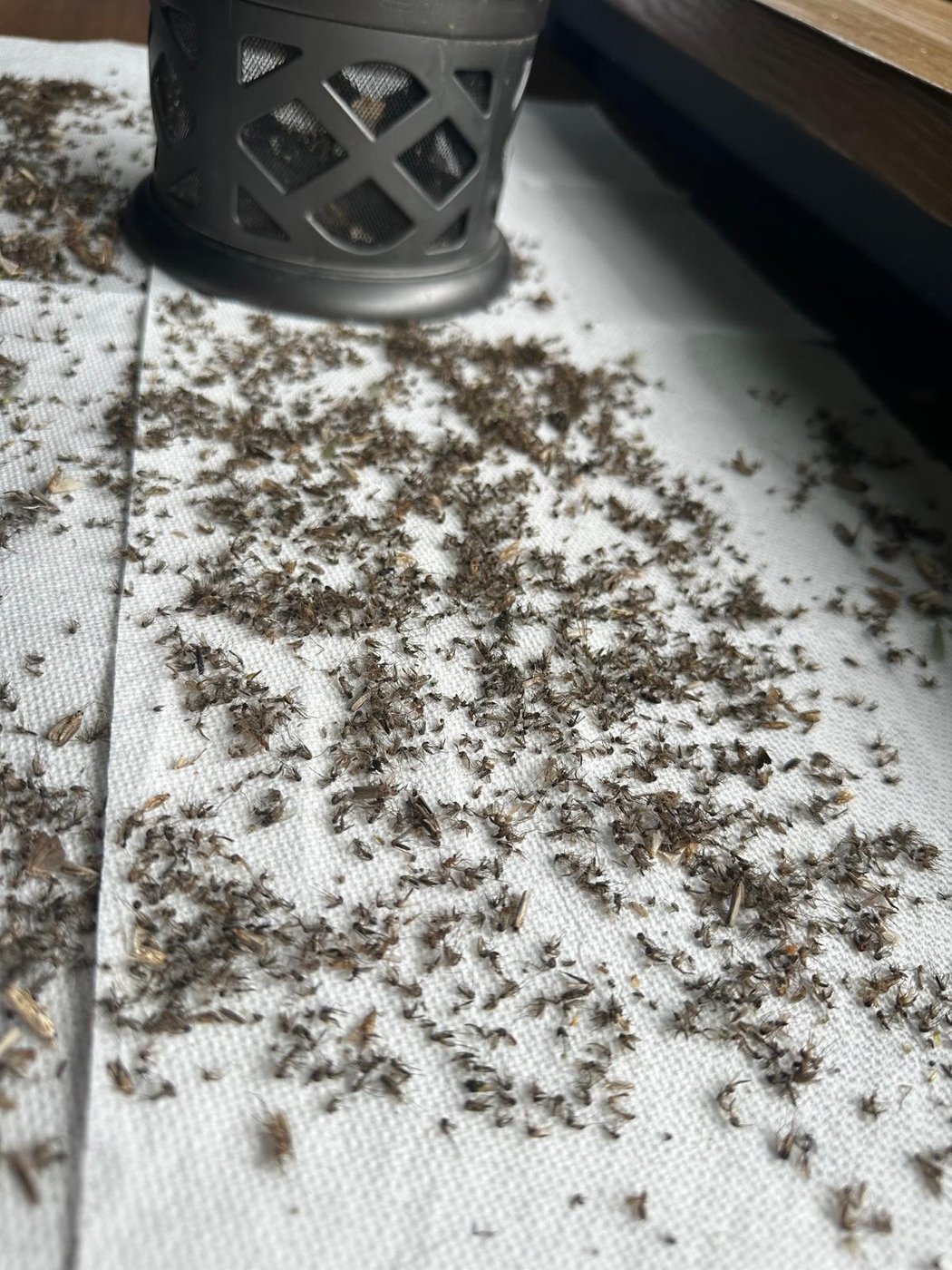
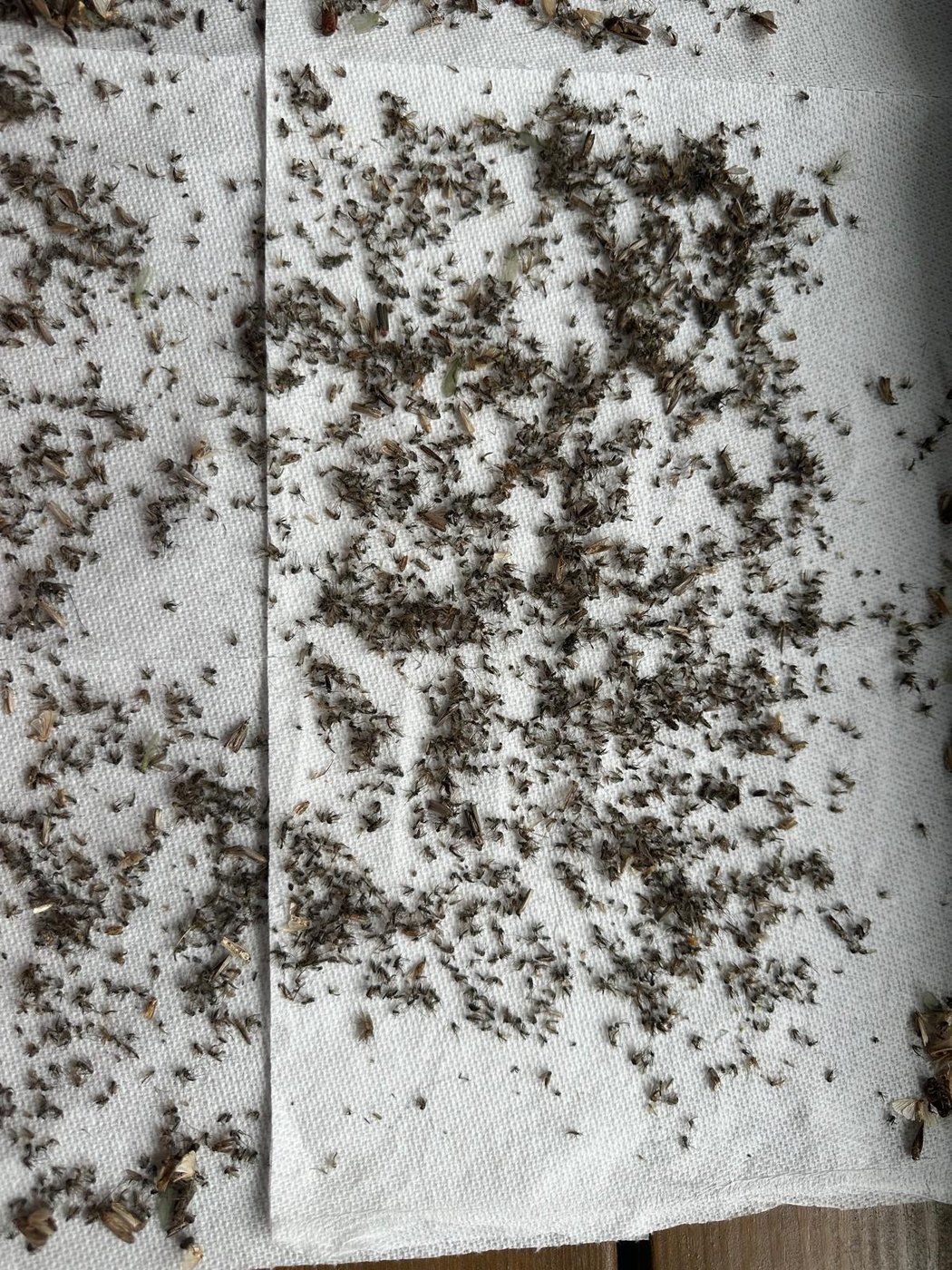
This is the contents of a single mosquito trap in one Shore Acres backyard, emptied after five days and spread out to be counted. Photographed August 3, 2026.

The contents of a backyard mosquito trap spread across white paper towel, with the trap's mesh collection basket standing alongside
Five days' catchThe trap's collection basket is visible at the top. Individual insects, long-legged and narrow-winged, are spread across the towel.
A wider view of the same collection spread across several sheets of white paper towel
Five days' catchThe same collection, spread wider. Every dark speck is an individual insect.

What this is, and what it is not

This is a five-day catch from one trap, in one yard, in a neighborhood where residents are also treating their own properties at their own expense.

It is therefore not a measure of the mosquito population. It is a measure of what remains after residents have already paid to reduce it.

On identification

Lantern-style traps are indiscriminate by design and catch other insects alongside mosquitoes. The photographs above show the trap contents as collected, not a sorted sample.

Formal identification by an entomologist is being sought, and this caption will be updated to reflect it. Nothing here depends on the species breakdown: the trap is a mosquito trap, five days is five days, and residents can see for themselves what is in their yards.

Evidence

Why parents describe this as a medical problem

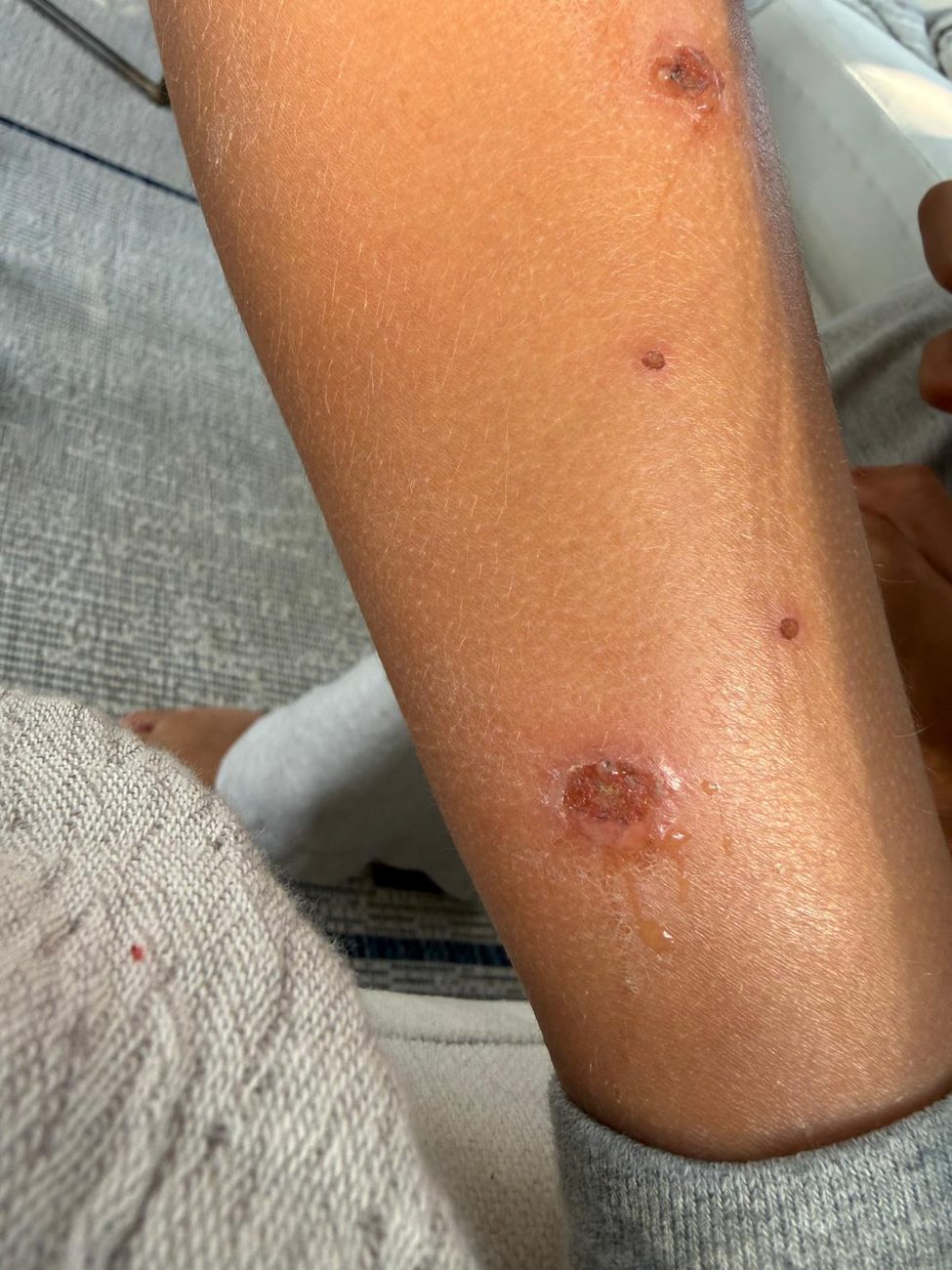
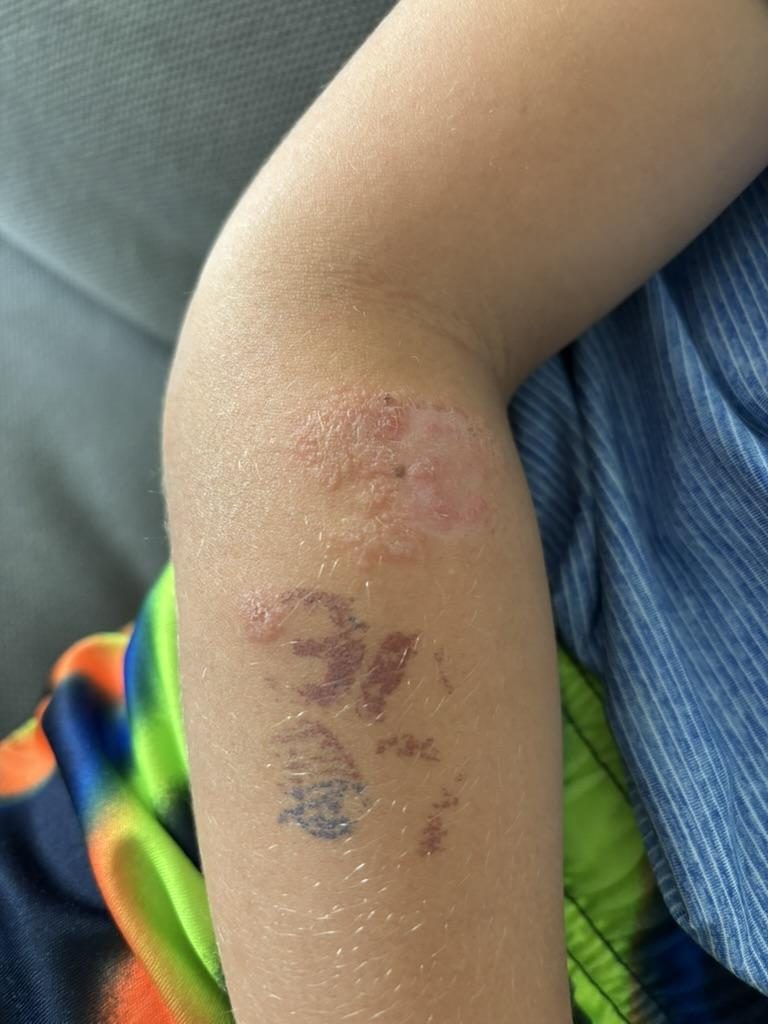
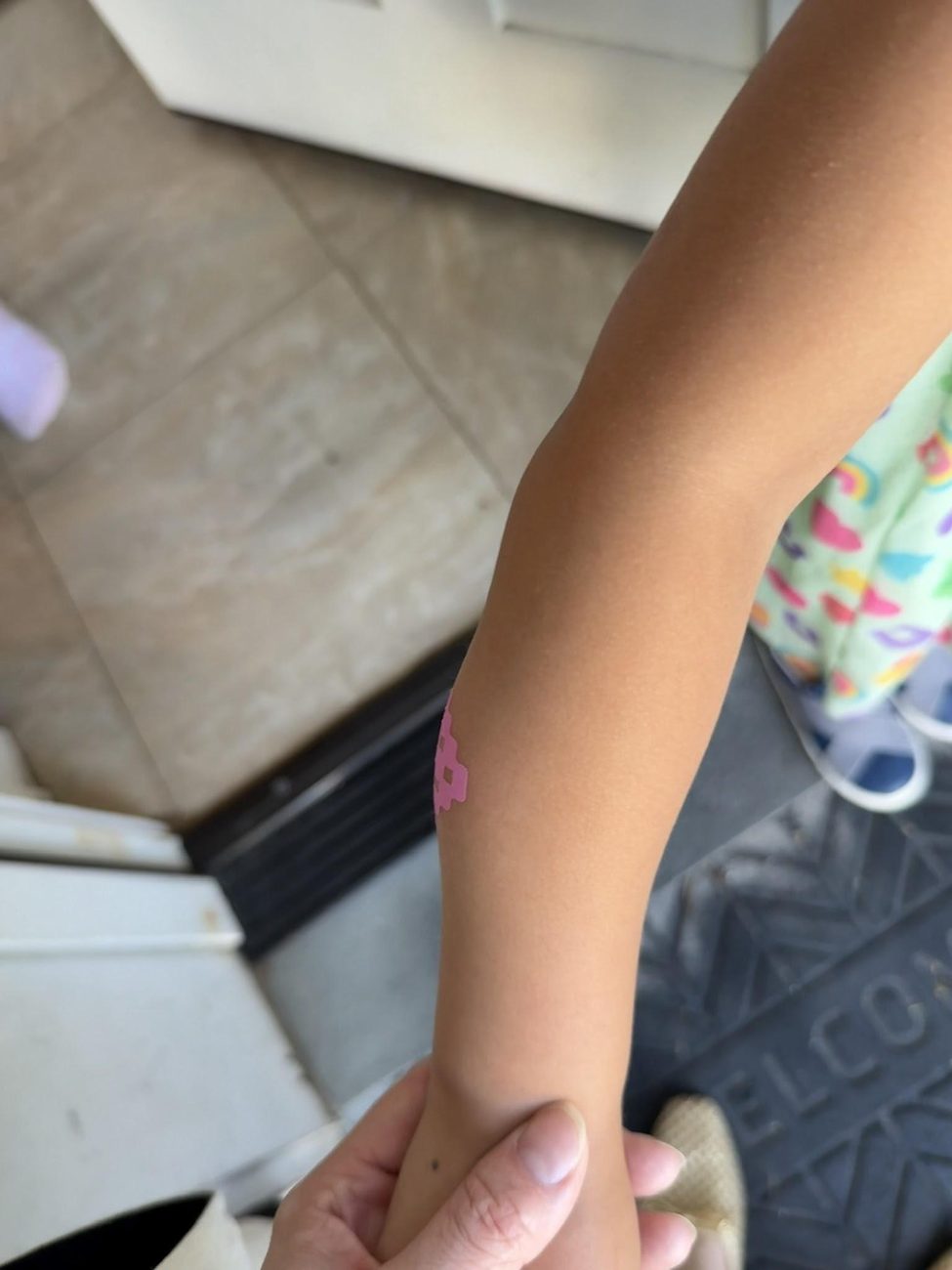
The formal request submitted to the Westchester County Department of Health on July 22, 2026, signed by 118 households, included photographs of injuries sustained by children in their own yards. Multiple children have required antibiotics for infected bites, steroids for severe allergic reactions, and follow-up pediatric care. At least one missed school with an eye swollen shut.

Show photographs of children's injuries
A child's lower leg with several raised, scarring bite lesions, one open and weeping
Bite injuryMultiple scarring welts and an open, weeping lesion, from bites sustained in the child's own yard.
A child's arm with a large healing lesion and further marked bite sites
Bite injuryA bite that progressed to a secondary skin infection, requiring weeks of antibiotic treatment.
A young child's arm being held by an adult, with a treated bite site
Bite injuryA young child's arm, treated. Reactions in this age group have been severe enough that a limb appeared fractured.

Submitted to Dr. Sherlita Amler, Westchester County Health Commissioner, July 22, 2026. Additional photographs and written accounts were offered and remain available on request.